

Tipping skips: efficient solutions for the transport and storage of bulk materials
Tipping skips are indispensable items of equipment for companies that operate in industry, logistics, construction and recycling. They enable efficient, safe and rapid handling of bulk materials, recyclable materials and production waste – from collection and transport right through to controlled emptying.
Whether it’s production waste, construction rubble, metal swarf or cardboard packaging: tipping skips are specifically designed to hold large quantities of a wide variety of materials and to be moved with minimal effort. Their full potential can be exploited in combination with forklift trucks or other industrial trucks, and they play a decisive role in optimising processes within the company.
Their robust construction, well designed tipping mechanisms and the wide range of models available make tipping skips a cost effective solution for in-house material management. They facilitate both the flow of materials and the disposal and interim storage of materials, thereby helping businesses to speed up workflows, reduce costs and, at the same time, improve occupational health and safety.
Potential uses for tipping skips in industry and logistics
The large number of potential uses for tipping skips means that they can be found in almost every industry. Their versatility makes them an indispensable component of modern intralogistics.
Production and manufacturing
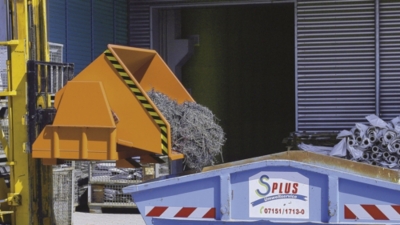
In manufacturing plants, tipping skips are primarily used for the collection and transport of:
- Production waste
- Metal swarf
- Residual materials and rejects/scrap
They help create structured processes and enable efficient waste disposal directly at source.
Warehouse and logistics
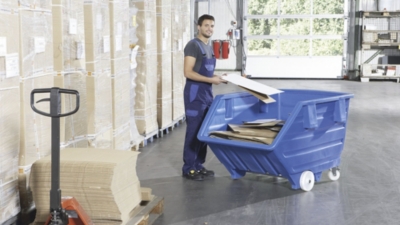
In warehouses and logistics centres, tipping skips help with:
- In-house transport of bulk materials
- Interim storage of materials
- Organising material flows
Due to their mobility and compatibility with stackers, processes can be expedited significantly.
Construction and waste management
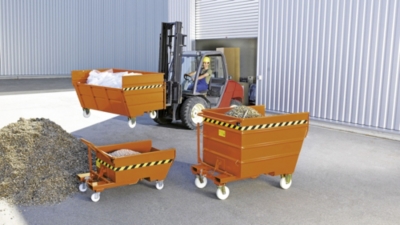
On construction sites and in the waste management sector, tipping skips are essential for the transport and storage of:
- Construction waste
- Soil, sand and gravel
- Recycled materials
They make fast and well managed unloading of large material quantities possible, and significantly increase efficiency on the building site.
Designs and operating principles
Most tipping skips are compatible with stackers and come with forklift pockets and a safety chain to prevent them from slipping off the stacker. However, there are also versions available with castors for manual movement or – for versatile use – models that are equipped with both forklift pockets and castors. The tipping angle is usually designed to ensure that the container is emptied completely.
The containers differ primarily in terms of the tipping mechanism used and the type of emptying. The main versions include:
Self-tipping containers
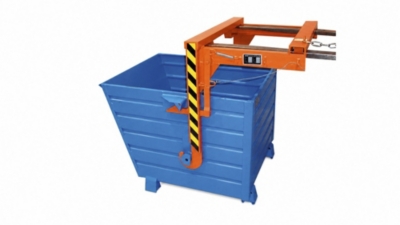
These compact tipping skips provide an optimum capacity and an ideal tipping angle, ensuring that they are emptied completely. The most widespread solution is to activate tipping process at any height directly from the stacker seat by using a cable pull – this saves time and prevents the user from having to dismount when emptying the container. Once enabled, the skip tips forwards and the content is emptied. Another option is to position the tipping skip on the edge of the container and, once enabled, empty it by slowly raising the stacker mast.
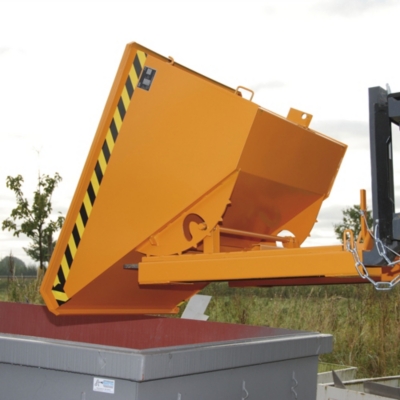
To prevent the tipping skip from suddenly tipping over the fork tips, a rolling mechanism will prove beneficial. In this case, the skip glides over a cam track with a controlled rolling motion and is emptied gently and evenly. This prevents impact stress on the stacker mast, as the load centre remains close to the stacker throughout the entire process. Depending on the model, the tipping process can be activated manually by using a pull rope or automatically by putting the container down, or applying pressure onto the edge of the container. The empty container returns to its starting position under its own weight and locks in place automatically, or the empty container is set down on the ground, where it assumes the loading position again.
In the case of tipping skips with a scissor mechanism, scissor type arms provide the container tray with a fixed connection to the base frame. So too in this case is the container guided throughout the entire tipping process, preventing the load from being dumped uncontrollably and thereby protecting both the stacker mast and the material. Scissor mechanisms are frequently used with lighter plastic containers.
Suspension tippers
These containers are a cost effective alternative as they do not feature an integrated tipping mechanism. The containers are suspended from a beam by pins or suspension points, and are unlocked mechanically or hydraulically. The beams usually feature forklift pockets for fork tips (for using a stacker) and often also feature crane eyelets for use with hoists.
Manual emptying
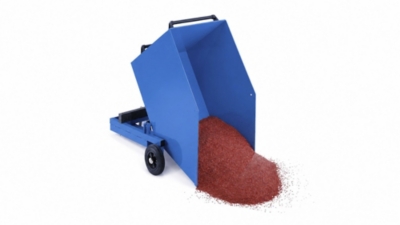
If no stacker is available, tipping skips are a suitable alternative; these are emptied by manually tipping them over the wheel axle. It is important to note that this method only allows for emptying at ground level or into a low lying pit. What’s more, they should not be used to collect heavy materials.
Hinged bottom skips
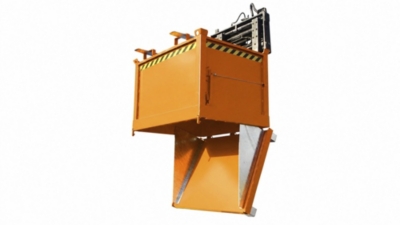
Hinged bottom skips provide a good alternative to tipping skips, particularly for the collection of very bulky materials. The large opening width of the base flap facilitates complete emptying, and the well balanced load centre allows the maximum load of the stacker to be utilised to the full.
Which tipping skip is best suited to which purpose?
Which tipping skip is the right one to choose depends largely on the materials being collected and handled, and is decisive for ensuring operational efficiency and safety. Different types of tipping skips are available to suit different requirements.
Steel tipping skips are the first choice for demanding applications. They are characterised by high stability and a high max. load, a robust frame construction and a long service life, and are particularly suitable for heavy materials such as scrap metal, building materials or production waste.
Plastic tipping skips provide many advantages when the main focus is on low weight, high level of resilience to chemicals and ease of cleaning. They are corrosion resistant and ideal for hygiene sensitive areas or for handling liquids and corrosive substances.
For specific requirements, special models are available that can be tailored to individual company needs, such as steel containers with reinforced bases for heavy metal or wood waste, or containers with smooth inner surfaces that are particularly suitable for collecting cardboard and plastic film.
Tipping skips for metal swarf enable chips and shavings to be separated from liquids and are primarily used by the metalworking industry for the collection, separation and disposal of metal swarf and lubricants (such as drilling emulsions or oil). They are usually welded to ensure they are oilproof and watertight to prevent lubricants from leaking during transport, and almost always feature integrated perforated metal plates or bases to separate liquids from solids. The solid swarf is retained while liquids can drain off at the bottom. A drain valve allows the liquid components to be drained and recycled as required.
Tipping skips for metal swarf with a low overall height have been specifically developed for machines with a low ejection height. They are ideal for production facilities and are easy to position next to machinery.
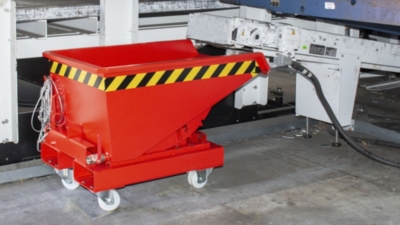
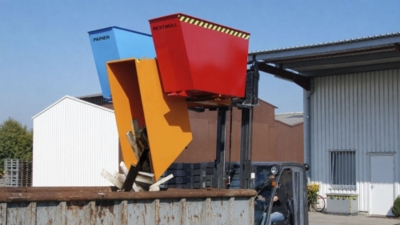
Multi-chamber containers with two or three separate compartments are ideal for sorting recyclable materials. These systems make it possible to collect different types of recyclable materials or waste at the same time and empty them separately, making them ideal for efficient waste sorting and recycling in industrial settings.
Each compartment can be unlocked and tipped individually. This means, for example, that scrap metal and plastic waste can be transported in one and the same work step, but be emptied into different containers. The individual compartments are often painted in different colours to make waste sorting intuitive for employees.
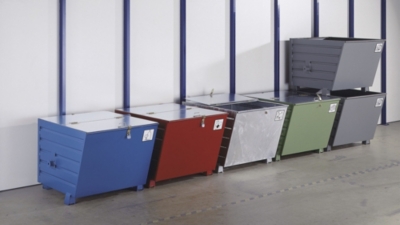
Stackable tipping skips have been specifically designed to save space when collecting, storing and disposing of bulk materials such as scrap metal, swarf or waste, and can be stacked on top of one another even when full. Robust corner posts or profiled metals sheets make them safe to stack, saving valuable storage space.
How do I find the right tipping skip for my requirements?
1. Determine what it is that you need
- What is the intended purpose and place of use for the tipping skip?
- What types of materials will the tipping skip used for (heavy/light, dry/wet, swarf)?
- How will the tipping skip be transported/emptied (manually, using a pallet truck/stacker, or by crane)?
2. Which model is required?
- Capacity (m³)?
- Max. load (kg)?
- Dimensions (mm)?
- Do the forklift pockets fit the forks (observe minimum fork length)?
3. Surface / accessories?
- Surface: painted / hot dip galvanised / plastic
- Castors? Observe the max. load of the castors!
- With or without a cover?
- Oilproof and watertight?
- Stackable?
- Any other requirements?
The benefits that tipping skips provide for your company
The use of tipping skips can significantly optimise work processes and reduce costs over the long term. Tipping skips offer numerous advantages for everyday work at companies:
- Efficient processes: fast collection, transport and emptying
- Time savings: automated tilting mechanisms reduce the amount of work required
- High level of safety: controlled emptying minimises risks
- Versatility: suitability for use with stackers, cranes or manually
- Durability: robust materials for long term use
FAQ – Frequently asked questions about tipping skips
What needs to be observed when using a tipping skip for a stacker?
Ensure that the tipping skip is suitable for the weight and size of the materials being transported. It is also important that the operator of the stacker has been briefed on correct handling of the tipping skip and follows the safety instructions. Check the tipping skip regularly for damage or wear and tear and, if necessary, arrange for it to be repaired or replaced. Always observe local regulations and guidelines for the disposal of recyclable materials.
Are there any legal requirements for tipping skips?
Tipping skips that are equipped with a device for operation with a forklift truck or industrial truck are covered by the forklift attachments category, and must therefore be inspected at regular intervals. The European basis for this risk assessment is set out in Directive 2009/104/EC, Article 4 and Annex I, concerning minimum safety and health requirements for the use of work equipment by employees at work.
How can I tell if my stacker and the tipping skip are compatible?
Make sure that the stacker forks are capable of lifting the container. Compare the fork dimensions (width x height) of your stacker with the dimensions of the forklift pockets of the tipping skip. What’s more, the stacker must be stable. Compare the max. load and load capacity chart of the stacker with the container’s load capacity specifications.
Which materials can be transported or stored in a tipping skip?
Tipping skips are versatile transport and storage equipment and are primarily used in industry, the construction sector and waste management to move bulk materials, waste and recyclable materials efficiently. They are suitable for transporting a wide variety of materials. They can be used to transport waste, rubble, scrap metal, soil, liquids and much more. While steel containers are the norm, special containers made of polyethylene (PE) are ideally suited for corrosive substances or as leakproof recyclable waste containers. The choice of the most suitable container depends on the weight and specific properties of the material being transported.
Are there any specific safety precautions that need to be observed?
Take care not to overload the container and to lock it securely before transport. Ensure that the stacker or industrial truck used to transport the container is stable. Make sure that the containers are not tipped near people.
Find the tipping skip that is most suitable for your requirements
Whether for manufacturing, logistics or construction: with the right tipping skip, you can optimise your processes over the long term. Choose from a wide range of models – tailored to your requirements and areas of use.

Contact us!
We are available to answer any further questions you might have.