

Legally compliant and safe storage of flammable liquids in safety cabinets
The storage of flammable liquids present particular challenges for companies that are active in production, laboratories and logistics. Even small quantities of substances with a low flash point can cause considerable damage in the event of a fire – to employees, property and operational processes. At the same time, there are clear legal requirements stipulating that substances like these must be stored safely and in accordance with the law.
This page provides a structured overview of the requirements that apply to the storage of flammable liquids in the workplace, and also explains the differences between active and passive storage, as well as showing why a suitable safety cabinet is the most important protective measure.
What are flammable liquids?
Flammable (or combustible) liquids are classified as hazardous substances which, once they catch fire, continue to burn in air. A decisive criterion in this context is a substance’s flash point. This refers to the lowest temperature at which a flammable mix of vapours and air can form above a substance. If this mixture comes into contact with a source of ignition, it may result in the mixture catching fire, or an explosion. The lower the flash point, the greater the potential hazard in a normal working environment will be.
Flammable liquids are divided into four different categories according to fire hazard that they present – based on their flash point and boiling point. The classification in accordance with the CLP Regulation applies to three of these categories and can be found in H-statements 224, 225 and 226 on product labels. Petroleum products are placed in a fourth category, regardless of their flash point.
Category 1 – H 224
Flash point: < 23 °C – ≤ 35 °C
Statement: extremely flammable liquid and vapour
Signal word: danger
Example: isopentane, diethyl ether
Category 2 – H 225
Flash point: < 23 °C – ≤ 35 °C
Statement: highly flammable liquid and vapour
Signal word: danger
Example: acetone, ethanol
Category 3 – H 226
Flash point: ≥ 23 °C – ≤ 60 °C
Statement: flammable liquid and vapour
Signal word: attention
Example: paints, many solvents
Category 4 – H 226
Flash point: –
Statement: flammable
Signal word: attention
Example: heating oil, diesel

Active and passive storage
Passive storage
Passive storage refers to the storage of flammable liquids in suitable containers. The containers must remain tightly sealed. No direct use in the form of refilling or emptying processes may occur.
Active storage
The term active storage is used when flammable liquids are regularly taken out of containers or refilled for use. This presents additional hazards due to the release of vapours from open containers and results in an increased risk of ignition. Special protective measures are required for this type of use.
Legal framework and requirements for the storage of flammable liquids
The flash point of the substance, or its respective category, determines which quantities of a flammable liquid may be stored under specific conditions.
Companies are obliged to store hazardous substances in a way that ensures that they do not endanger human health or the environment. Storage refers to keeping hazardous substances for later use or to supply to third parties. This includes providing them for transport or unloading, for example, if this is not completed within 24 hours of starting the work or on the following working day. If this working day is a Saturday, the deadline expires when business ends the next working day. Misuse or improper use must be prevented. The storage of hazardous substances in containers intended for foodstuffs is prohibited.
This results in the following criteria and protective measures:
- Storage in suitable, tightly sealed containers only
- Limitations to the quantity of stock allowed in the work area
- Protection from unauthorised access
- Avoidance of any sources of ignition
- Labelling in accordance with legislation on hazardous substances
- Provision of suitable fire extinguishing agents
- Collection options in the event of leaks
Empty containers that have not been cleaned are also subject to the same safety regulations as full ones!
The quantity of flammable liquids that may be kept ready for use in a work area is limited to the amount required during a working day or shift. Any quantities that exceed this must be stored in appropriately equipped storage rooms, unless a suitable safety cabinet is being used for storage.
What’s more, not every area within the company is suitable or even approved for the storage of flammable substances. To prevent fires, explosions or other hazards, flammable liquids must not be stored in the following areas, nor be placed there for short periods:
- Escape and emergency routes
- Staircases
- Areas where substances are exposed to heat
- Break rooms and common rooms
- Corridors and passages open to the public
Traffic routes and highly frequented work areas must also be assessed critically. The objective is to prevent the spread of fire and to ensure safe evacuation routes at all times.
In many companies, flammable liquids are part of everyday work. Typical areas of use include:
- Production facilities: paints, thinners, cleaning agents, solvents, technical liquids
- Workshops: petrol, brake cleaner, oils, hazardous goods containers, spray cans
- Laboratories and testing departments: chemicals with a low flash point, self-igniting substances
These substances are often required directly at the workplace. However, this is exactly where there is a higher risk if no suitable protective measures are implemented.
In addition to organisational measures such as risk assessments, regular employee training, the documentation of quantities kept in storage and regular checks of the condition of the storage area, technical measures such as the use of suitable safety cabinets also take priority.
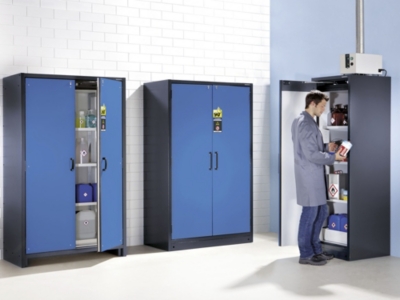
Why suitable security cabinets are absolutely essential
Safety cabinets used for the storage of flammable liquids are primarily classified by type according to their level of fire resistance. This is regulated by the European standard EN 14470-1. This classification specifies the number of minutes it takes for the temperature inside the cabinet to rise by 180 K in the event of a fire (the unit K = Kelvin is used to express temperature differences).
The main type classifications according to EN 14470-1 are:
Type 90: this type provides the highest level of protection, with a fire resistance rating of at least 90 minutes. These cabinets are standard equipment for the storage of flammable liquids in workrooms in accordance with EN 14470-1 and there are no limitations on their use. These cabinets feature fire resistant insulation, have been subject to fire testing and are fitted with self-closing doors in the event of a fire.
Type 60: this type provides a fire resistance level of at least 60 minutes.
Type 30: this type provides a fire resistance level of at least 30 minutes and only has limited approval for storing flammable substances in work areas.
Type 15: this type provides a fire resistance level of at least 15 minutes.
Type 90 (F90) safety cabinets are now regarded as the gold standard when it comes to the storage of hazardous substances in work areas. In production facilities or logistics areas in particular, where substances must be kept readily available, the Type 90 safety cabinet represents the most practical and legally compliant solution.
The use of Type 90 safety cabinets in accordance with EN 14470-1 for the storage of flammable liquids in workrooms brings clear benefits:
- Fulfilment of elementary requirements for fire and explosion protection
- Quick and effective placement of hazardous substances in storage in safety cabinets at the end of the working day
- Minimisation of unsafe storage of hazardous substances at the workplace
- Reduction of the in-house transport of hazardous substances and the associated risks
- Flexibility of storage locations
- Storage spaces can be exploited more effectively
Please note: safety cabinets may also be installed in corridors in consultation with the local fire services, provided that they do not restrict the width of the escape routes. Please check with the relevant authorities for further information.
Explosion protection measures in the context of safety cabinets
Zone allocation
Ex zones (explosion protection zones) classify areas where there is a risk of explosions based on the frequency and duration for which an explosive atmosphere forms. The following zones, where gases, vapours or mists are present, are distinguished in accordance with ATEX:
- Zone 0: continuously present for long periods or frequently
- Zone 1: occasionally during normal operation
- Zone 2: unlikely and occurrence only for a short time
The storage of flammable liquids makes an explosion protection plan essential in order to prevent sources of ignition and to control explosive atmospheres (Ex zone 1 or 2 inside the cabinet).
According to DGUV Rule 113-001 (EX-RL), the interior of safety cabinets compliant with EN 14470-1 is usually classified as zone-free when there is active and monitored forced ventilation (the air is exchanged at least 10 times per hour) in operation, provided that only sealed containers are stored in it. If the cabinet is not ventilated, or if open or leaking containers are stored, the entire interior must be classified as Zone 2 (unlikely to occur, and any explosive atmosphere only for a short period). The interior of the exhaust duct is classified as being the same zone as the interior of the cabinet. As a general rule, no zone needs to be defined for the work area outside a safety cabinet with forced ventilation, provided there are no other sources of emissions.
A binding classification must be made by a qualified person as part of the risk assessment!

Forced ventilation
The necessity of forced ventilation and the specific requirements of it are set out in various regulations, including the EN 14470-1 standard for safety cabinets for flammable liquids.
A forced ventilation system for safety cabinets is essential to prevent an explosive atmosphere from building up inside the cabinet during normal operation and to safely discharge vapours. The exhaust air must, as a rule, be conducted to a safe location – usually outdoors – or be purified using a recirculation filter.
The main function of forced ventilation is to continuously extract potentially hazardous gases or vapours that may be emitted by chemicals in storage. As many flammable vapours are heavier than air, they settle close to the floor, which is why the extraction point is usually installed at the bottom of the cabinet. This continuous air exchange keeps the concentration of vapours below relevant limit values (e.g. the explosion limit).
When storing highly volatile or toxic substances, a minimum air exchange rate is often stipulated, which is typically ten air changes per hour. For flammable liquids in work areas with forced ventilation, this type of ventilation can reduce the extent of the potentially explosive atmosphere around the cabinet. The ventilation system must, as a rule, be monitored. If the ventilation fails, this must be indicated by a visual or audible signal and, where necessary, alternative measures must be taken.
Recirculating air filter module
As an alternative to mechanical ventilation, a recirculating air filtration unit can be used, which enables ventilation without a direct connection to an exhaust air system by filtering out pollutants and returning the purified air to the room. Recirculating air filtration units are particularly suitable wherever it is not possible to connect to an exhaust air system due to the building’s structure. Regular maintenance and continuous filter monitoring are absolutely essential.
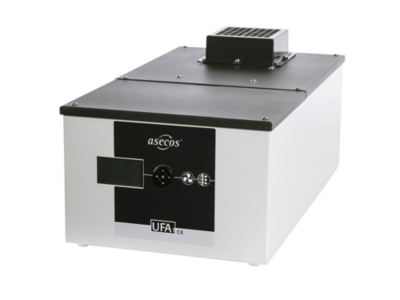
Suitable safety cabinets in accordance with EN 14470-1 – the key requirements
Safety requirements
- Minimise the risk of fire associated with the storage of flammable substances and protect the contents of the cabinet in the event of fire for a specific (tested) period of time.
- Minimise vapours emitted into the working environment.
- Containment of potential leaks within the cabinet.
- The standard stipulates sufficient time for employees to evacuate the work area and for firefighters to gain access to the building before the flammable materials in storage can result in an uncontrolled fire.
Fire resistance
- Test in a suitable fire chamber as an individual, free-standing cabinet.
- The entire cabinet must be exposed to uniform heat conditions.
- Burn test in accordance with the temperature-time curve EN 1363-1 (5.1.1).
- The increase in temperature is measured in the cabinet (13 measuring points on the surfaces and the air).
- Classification of the cabinet as type 15, 30, 60 or 90.
Doors
- They must close fully from any position (closing time max. 20 seconds).
- Integrated arrest systems must release doors fixed in place at a temperature of 50 °C (+0/–10 °C).
Ventilation
- Air intake and exhaust openings are mandatory.
- The ventilation openings must close automatically at a temperature of 70 °C (±10 °C).
Shelves and drawers
- The shelves and drawers must be able to bear the max. load specified by the manufacturer for the duration of the fire.
Base sump tray
- The base sump tray must retain its functionality after the duration of the fire.
- Visual inspection (filling the base sump tray with water).
Information to be included
Operating instructions with information on the max. load of shelves or drawers in the cabinet, the capacity of the base sump tray, recommendations for inspection and maintenance, manufacturer's declaration of conformity or certificates of conformity from an authorised materials testing institute.
Marking and labelling
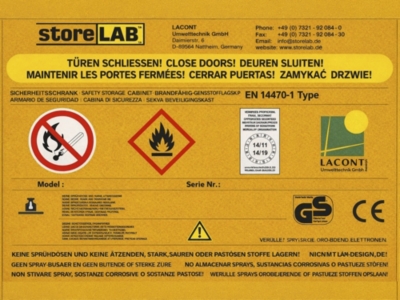
- Sign: Keep doors closed after use
- Warning symbols “Caution: Risk of fire” and “Fire: Open flames and smoking prohibited” in accordance with ISO 3864
- The fire resistance in minutes in accordance with EN 14470-1
- Name and/or trademark of the manufacturer
- Model number and year of manufacture
A certified safety cabinet provides:
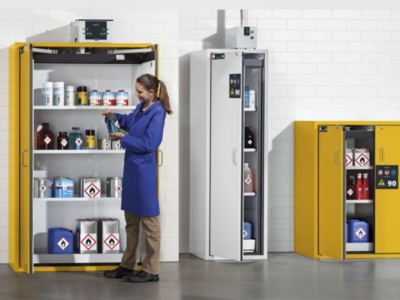
- Protection for employees
- Reduction of the risk of fire and explosion
- Tested fire resistance
- Automatic door closure in the event of a fire
- Smoke tight construction
- Integrated base sump
- Ventilation connection or recirculation filter
- Protection of the contents of the cabinet
- More time for evacuation and fire fighting
- Labelling in accordance with GHS
- Reduction of liability risks
Type 90 safety cabinets meet stringent fire safety requirements and allow flammable liquids to be stored in the workplace.
Safe and compliant with the law by using the right storage solution
The storage of flammable liquids is not a minor issue, but rather a key component of workplace fire safety. Companies are obliged to systematically minimise risks and comply with legal requirements. By opting for certified safety cabinets at an early stage, companies can establish clear procedures, protect their business and ensure that they meet legal requirements.
Discover our solutions for the safe and compliant storage of flammable liquids and find the right model to suit your needs.
Glossary of terms and abbreviations used
ATEX:
Stands for “Atmosphères Explosibles” (explosive atmospheres) and refers to two EU Directives (2014/34/EU for products, 1999/92/EC for operators) which regulate explosion protection. They require manufacturers to label equipment intended for use in hazardous areas and operators to classify these areas (0–2 for gas, 20–22 for dust).
CLP:
The CLP Regulation is an EU chemicals regulation and stands for “Classification, Labelling and Packaging”, which refers to the classification, labelling and packaging of substances and mixtures. The CLP Regulation implements the UN’s Globally Harmonised System of Classification and Labelling of Chemicals (GHS) within the European Economic Area.
EN 14470-1:
European standard for safety cabinets used to store flammable liquids in workplaces. It classifies cabinets based on their fire resistance and sets out requirements for fire protection, leak containment and ventilation.
EN 1363-1:
European standard that represents the basis for fire resistance tests. It sets out the general requirements and principles according to which components are tested for their resistance to fire.
GHS:
Stands for “Globally Harmonised System of Classification, Labelling and Packaging of Chemicals” and regulates the classification and labelling of chemicals, as well as their labelling on packaging and in safety data sheets. It is updated every two years, so the latest version must be taken into account whenever the GHS is referred to.
H and P-statements:
Hazard statements and precautionary statements are standardised, concise safety instructions for hazardous substances, which are used as part of the Globally Harmonised System of Classification and Labelling of Chemicals (GHS).
ISO 3864:
The ISO 3864 series of standards defines international standards for safety colours, safety signs and markings in workplaces and public areas, with the aim of preventing accidents and health risks by establishing uniform, language independent signage.

Contact us!
We are available to answer any further questions you might have.