

8 questions on first aid at the company
Note: The following information is based on European directives and generally accepted safety standards. Please be aware that national regulations and standards apply in each country. For more detailed information, please contact your local occupational safety authority or trade association.
Despite taking all preventive measures, accidents at work cannot be avoided altogether. This is why it is all the more important to be able to react quickly in an emergency. What does “first aid” actually refer to in a workplace context – and how do you ensure that it can be guaranteed at all times?
This guide tells you what you should pay attention to when it comes to first aid in the company, which European regulations apply and which products you will need to provide first aid to your employees.

Which legal bases apply?
Organising first aid in the workplace is a fundamental obligation for every employer. At European level, this obligation is specifically defined in Framework Directive 89/391/EEC, which covers occupational safety and health.
It specifies that the employer must:
- Take appropriate measures to prevent accidents at work
- Ensure that first aid, fire fighting and evacuation measures are guaranteed in the event of an emergency
- Appoint qualified personnel and provide the necessary equipment
- Provide employees with regular information about emergency measures.
Implementation in practice and details of these requirements are regulated by national provisions that define the EU requirements in more specific terms.
What needs to be observed in relation to first aid supplies?
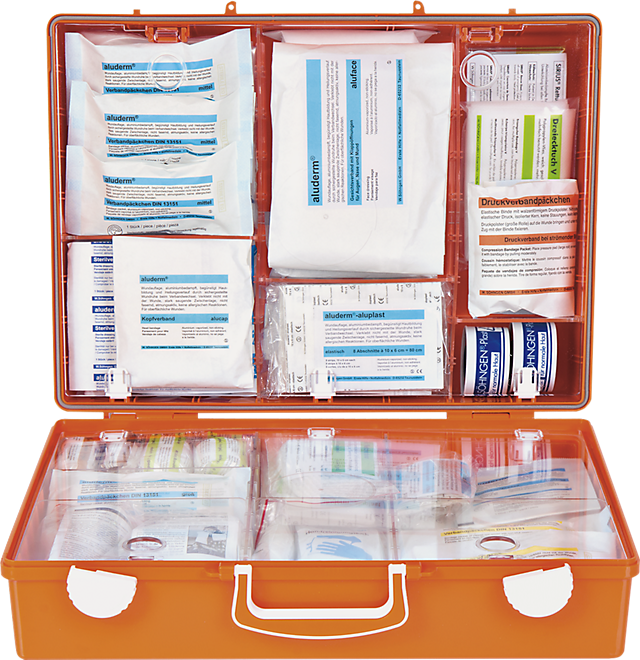
First aid supplies include first aid kits, first aid cabinets and mobile first aid cases. The model that is most suitable for your company depends on the working environment and the potential risks.
- First aid kit: compact, can be placed in cabinets or vehicles
- First-aid cabinet: installed in a fixed position and marked to ensure visibility
- First aid case: portable and can be combined with a wall bracket
The supplies must be easy to access, be complete and be checked regularly. Ensure that no expired or damaged products are in use.
Documenting all first aid rendered, for example in a first aid book, is a good practice to maintain. These records help to analyse the causes of accidents and optimise safety measures in the company.
How many first aid supplies are required?
The quantity required depends on the type of work, the size of the company and the risk assessment.
Orientation is provided by Europe-wide standards for bandaging materials such as:
- DIN 13157 (small first aid kit)
- DIN 13169 (large first aid kit)
A large first aid kit contains around twice the number of supplies that the smaller model contains. Many EU countries recognise these DIN standards or comparable EN standards.
The following rule of thumb applies:
- In administrative and commercial environments, a small first aid kit is usually sufficient for up to 50 employees.
- Larger or additional kits are required in production environments, in trades or on construction sites, usually for every 10 to 20 people.
A risk assessment helps to determine which exact equipment is suitable.
Are there regulations governing the shelf life of first aid supplies?
Items such as compresses or bandages that come in sterile packaging feature a expiration date. Once this date has passed, they may no longer be used as the sterility or function (e.g. adhesive strength) can no longer be guaranteed. Non-sterile products, such as triangular cloths or emergency blankets, only need to be replaced after use.
A regular maintenance and renewal plan ensures that all first aid supplies remain effective and ready for use.
Do special requirements apply for certain occupations?
The risk of injury varies greatly between different industries. While office environments usually only see minor cuts or falls, severe injuries can occur in industrial environments or on construction sites.
There are industry-specific first aid supplies for different areas of work, which contain more than the standard contents, such as:
- Eye wash for chemical facilities or workshops
- Cold sprays, respiratory masks or bags for severed limbs for production environments
- Special vehicle kits for mobile workplaces or logistics companies
Cases and kits come with extension modules to suit requirements.
What needs to be observed when transporting the injured?
When transporting injured persons within the company, it is crucial for this to be done in a gentle, safe and appropriate manner. Portable rescue systems are used for this, such as:
- Stretchers and folding stretchers
- Scoop stretchers for confined spaces
- Basket stretchers for uneven ground or construction sites
Does every company have to provide a first aid station?
A first aid station is recommended for companies with a large number of employees or where there is a higher level of risk.
This station is used to provide temporary care and rest for injured persons. In many countries, the requirements for the size, equipment and markings are based on the EN ISO 7010 guideline (safety marking) and national workplace guidelines.
Examples of equipment:
- Patient bed
- Washing facilities
- First aid cabinet
- Emergency telephone or other means of communication
Are there any other utensils that are used for first aid?
Depending on the risk level, supplementary products can save lives or minimise injuries, such as:
- Eye wash bottles or full body showers
- Fire extinguishers
- Emergency kit for chemical burns
- Safety cutters for freeing trapped persons quickly
Please remember: marking and accessibility of all first aid facilities are also decisive – every second counts in an emergency.